Environments, Vol. 11, Pages 53: Investigating the Sorption/Desorption of the Cationic Herbicide Paraquat in Clay Minerals Using Batch and Electro–Ultrafiltration Techniques
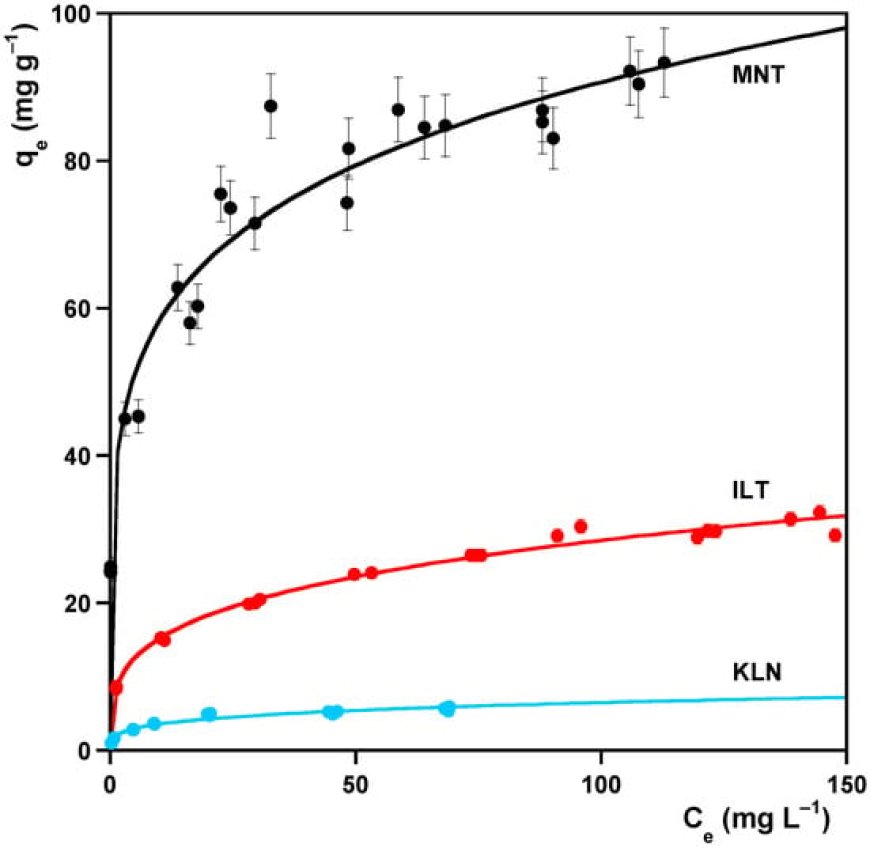
The sorption/desorption processes of the cationic herbicide paraquat (PQ) onto various clays, namely, kaolinite (KLN), illite (ILT), and montmorillonite (MNT), were investigated. After the attainment of sorption equilibrium, PQ was extracted from the clays by a double-stage desorption process utilizing an electro–ultrafiltration (EUF) procedure. The Freundlich isotherm model and a pseudo-first kinetic release model were found to adequately fit the sorption and desorption data, respectively. The experimental maximum sorbable amounts of paraquat were 5.56, 31.88, and 91.63 mg g−1 for KLN, ILT, and MNT, respectively, consistently with the order of magnitude of the cation-exchange capacity (CEC) of the clay minerals. The desorption experiments revealed that the amounts of PQ retained by the MNT samples were significantly larger than the respective amounts retained by KLN or ILT. The EUF-PQ desorption patterns of differently cation-saturated MNT samples indicated that the presence of monovalent cations could further hamper PQ release, while the opposite seemed to be true for divalent cations. Our results clearly show that a substantial aliquot of PQ is strongly retained by montmorillonite, probably via interlayering, thus suggesting that smectitic clays could act as a stable soil sink for cationic herbicides such as paraquat, favoring soil long-term contamination.
Environments, Vol. 11, Pages 53: Investigating the Sorption/Desorption of the Cationic Herbicide Paraquat in Clay Minerals Using Batch and Electro–Ultrafiltration Techniques
Environments doi: 10.3390/environments11030053
Authors: Stefano Salvestrini Eleonora Grilli Elio Coppola
The sorption/desorption processes of the cationic herbicide paraquat (PQ) onto various clays, namely, kaolinite (KLN), illite (ILT), and montmorillonite (MNT), were investigated. After the attainment of sorption equilibrium, PQ was extracted from the clays by a double-stage desorption process utilizing an electro–ultrafiltration (EUF) procedure. The Freundlich isotherm model and a pseudo-first kinetic release model were found to adequately fit the sorption and desorption data, respectively. The experimental maximum sorbable amounts of paraquat were 5.56, 31.88, and 91.63 mg g−1 for KLN, ILT, and MNT, respectively, consistently with the order of magnitude of the cation-exchange capacity (CEC) of the clay minerals. The desorption experiments revealed that the amounts of PQ retained by the MNT samples were significantly larger than the respective amounts retained by KLN or ILT. The EUF-PQ desorption patterns of differently cation-saturated MNT samples indicated that the presence of monovalent cations could further hamper PQ release, while the opposite seemed to be true for divalent cations. Our results clearly show that a substantial aliquot of PQ is strongly retained by montmorillonite, probably via interlayering, thus suggesting that smectitic clays could act as a stable soil sink for cationic herbicides such as paraquat, favoring soil long-term contamination.
What's Your Reaction?