Environments, Vol. 11, Pages 23: Fungal Arsenic Tolerance and Bioaccumulation: Local Strains from Polluted Water vs. Allochthonous Strains
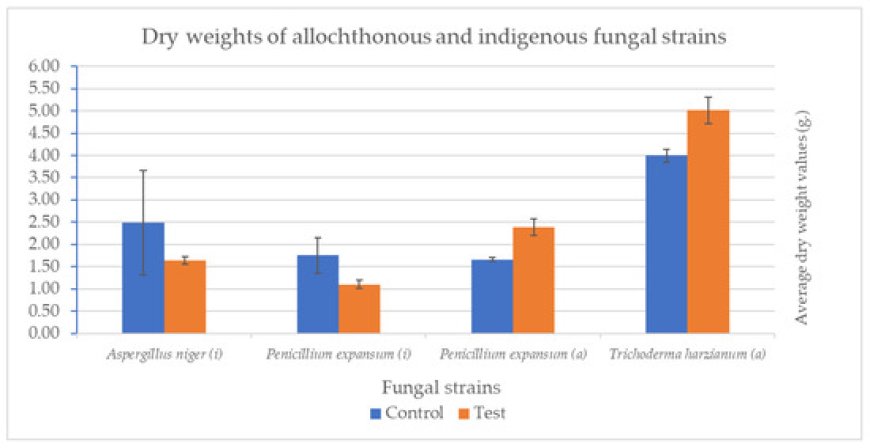
The paper deals with the possible use of fungi to decontaminate polluted waters. Specifically, the focus is the selection of the most promising fungal strain capable of bioaccumulating arsenic, which is a globally widespread environmental contaminant. To this aim, allochthonous fungal strains from the ColD UNIGE JRU MIRRI strains collection were selected. Their capability to survive and accumulate this kind of pollutant was evaluated and compared with that of an autochthonous fungi set directly isolated from the arsenic polluted water. A preliminary screening at various concentrations of arsenic (0, 200, 400, 800, 1600 μg L−1) revealed that the best performing strains were Aspergillus niger and Penicillium expansum among the autochthonous strains and Aspergillus niger and Penicillium expansum among the allochthonous strains. Moreover, all the strains were subjected to bioaccumulation tests at a 1600 μg L−1 concentration. Local and allochthonous fungal strains showed different behaviors: the allochthonous strains grew rapidly and in a sustained way but without expressing any bioaccumulation activity. On the contrary, the indigenous fungi, despite a moderate growth, showed a good bioaccumulation capacity (in particular, Aspergillus niger). The results highlight the importance of employing native strains isolated from contaminated matrices to make a mycoremediation protocol more efficient.
Environments, Vol. 11, Pages 23: Fungal Arsenic Tolerance and Bioaccumulation: Local Strains from Polluted Water vs. Allochthonous Strains
Environments doi: 10.3390/environments11010023
Authors: Laura Canonica Grazia Cecchi Vittorio Capra Simone Di Piazza Alessandro Girelli Sandro Zappatore Mirca Zotti
The paper deals with the possible use of fungi to decontaminate polluted waters. Specifically, the focus is the selection of the most promising fungal strain capable of bioaccumulating arsenic, which is a globally widespread environmental contaminant. To this aim, allochthonous fungal strains from the ColD UNIGE JRU MIRRI strains collection were selected. Their capability to survive and accumulate this kind of pollutant was evaluated and compared with that of an autochthonous fungi set directly isolated from the arsenic polluted water. A preliminary screening at various concentrations of arsenic (0, 200, 400, 800, 1600 μg L−1) revealed that the best performing strains were Aspergillus niger and Penicillium expansum among the autochthonous strains and Aspergillus niger and Penicillium expansum among the allochthonous strains. Moreover, all the strains were subjected to bioaccumulation tests at a 1600 μg L−1 concentration. Local and allochthonous fungal strains showed different behaviors: the allochthonous strains grew rapidly and in a sustained way but without expressing any bioaccumulation activity. On the contrary, the indigenous fungi, despite a moderate growth, showed a good bioaccumulation capacity (in particular, Aspergillus niger). The results highlight the importance of employing native strains isolated from contaminated matrices to make a mycoremediation protocol more efficient.
What's Your Reaction?