Environments, Vol. 10, Pages 222: Migration of Artificial Turf Fibers from Artificial Turf Sports Field and Their Ingestion by Goldfish
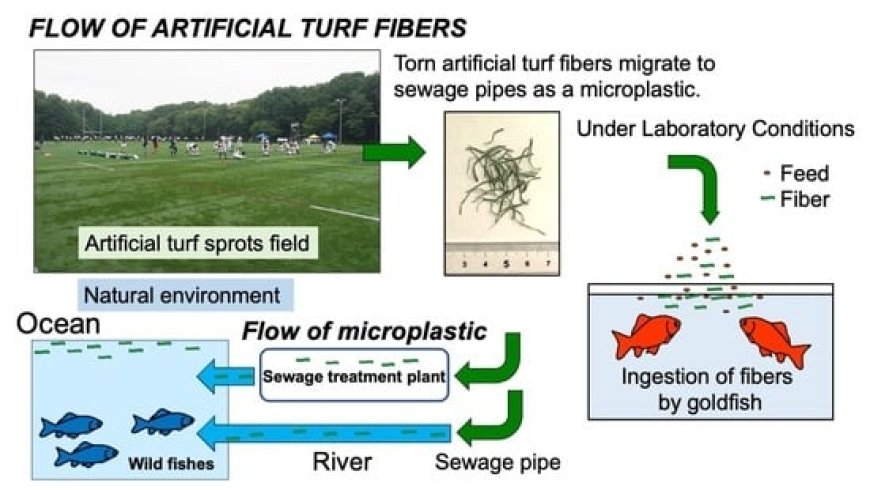
Various artificial materials and facilities are sources of microplastics, including artificial turf sports fields. In artificial turf fields, polyethylene fibers are attached to a basal cloth with adhesives. In the present study, we investigated whether the fibers in the field were detached from the basal cloth or torn in the field, and whether they moved to the surrounding ditches that were connected to sewage pipes. In the field, we collected fibers shorter in length compared to the original and these were free from basal cloth, indicating the tearing of the fibers due to players’ activities. We also collected fibers from the ditches, which indicated a migration of the fibers from the field into the ditches. These results suggest that the fibers in ditches could enter sewage treatment plants and be released into the aquatic environment as microplastics. We also examined whether goldfish, Carassius auratus, ingested these fibers, and observed that the fish ingested them with feed while the fish did not without feed. These results indicate that the fiber ingestion by the fish occurred unintentionally when they swallowed their feed. The present study demonstrated that artificial turf fibers in sports fields could turn into microplastics that can be ingested by wild fishes.
Environments, Vol. 10, Pages 222: Migration of Artificial Turf Fibers from Artificial Turf Sports Field and Their Ingestion by Goldfish
Environments doi: 10.3390/environments10120222
Authors: Kanoko Takahashi Ryosuke Fujinuma Tomoyasu Yoshitomi Yasuo Shimizu Makito Kobayashi
Various artificial materials and facilities are sources of microplastics, including artificial turf sports fields. In artificial turf fields, polyethylene fibers are attached to a basal cloth with adhesives. In the present study, we investigated whether the fibers in the field were detached from the basal cloth or torn in the field, and whether they moved to the surrounding ditches that were connected to sewage pipes. In the field, we collected fibers shorter in length compared to the original and these were free from basal cloth, indicating the tearing of the fibers due to players’ activities. We also collected fibers from the ditches, which indicated a migration of the fibers from the field into the ditches. These results suggest that the fibers in ditches could enter sewage treatment plants and be released into the aquatic environment as microplastics. We also examined whether goldfish, Carassius auratus, ingested these fibers, and observed that the fish ingested them with feed while the fish did not without feed. These results indicate that the fiber ingestion by the fish occurred unintentionally when they swallowed their feed. The present study demonstrated that artificial turf fibers in sports fields could turn into microplastics that can be ingested by wild fishes.
What's Your Reaction?