Climate, Vol. 12, Pages 65: A Survey of African Weather and Climate Extremes
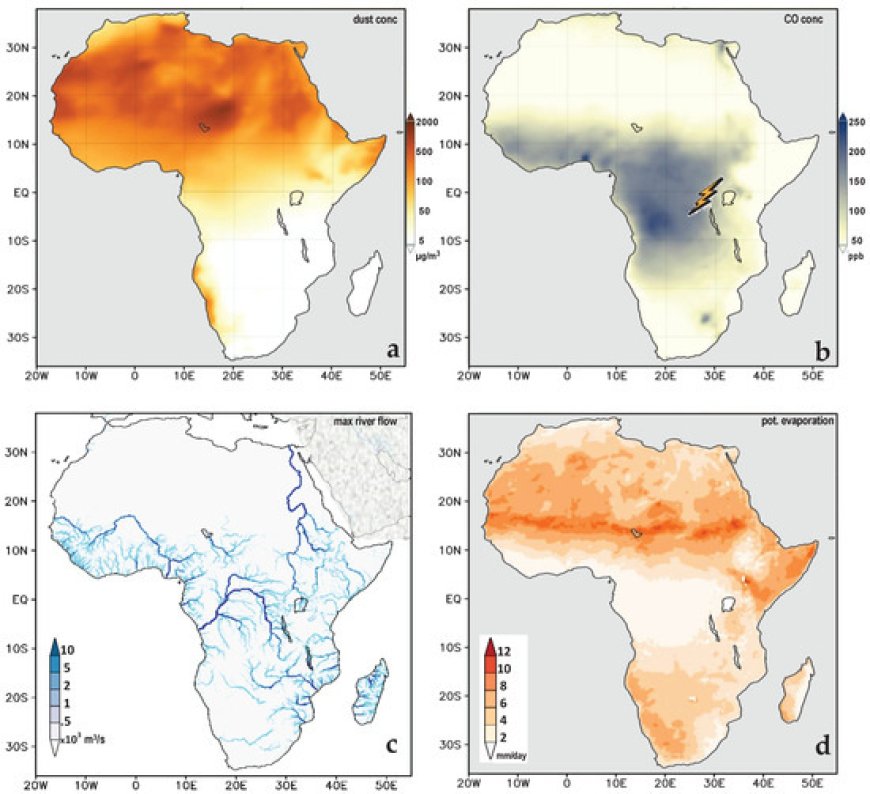
A survey of African weather and climate extremes in the period 1970–2023 reveals spatial and temporal patterns of intense dry and wet spells, associated with meteorological conditions and consequences. Seasonal wind storms occur along coasts facing the Mozambique Channel, the Gulf of Guinea, the Mediterranean, and the Southern Ocean. Desiccating evaporation is found along the edge of the Sahara and Kalahari Deserts, as well as in lowland subtropical river valleys. The Palmer Drought Severity Index (PDSI) and net outgoing longwave radiation (OLR) reflect precipitation–evaporation balance and guide regional evaluation. Temporal fluctuations are dominated by inter-decadal oscillations and drying/moistening trends over Southeast/West Africa, respectively. Localized floods and droughts are frequent, but widespread impacts are rare, suggesting that the transfer of resources from surplus to deficit regions is possible. Various case studies focus on (i) tropical cyclone impacts, (ii) monsoon moisture flux, and (iii) coastal upwelling. African communities have become resilient in the face of extreme weather and have shown that adaptation is possible, but further mitigating efforts are needed so that macro-economic progress does not come with harmful secondary consequences.
Climate, Vol. 12, Pages 65: A Survey of African Weather and Climate Extremes
Climate doi: 10.3390/cli12050065
Authors: Mark R. Jury
A survey of African weather and climate extremes in the period 1970–2023 reveals spatial and temporal patterns of intense dry and wet spells, associated with meteorological conditions and consequences. Seasonal wind storms occur along coasts facing the Mozambique Channel, the Gulf of Guinea, the Mediterranean, and the Southern Ocean. Desiccating evaporation is found along the edge of the Sahara and Kalahari Deserts, as well as in lowland subtropical river valleys. The Palmer Drought Severity Index (PDSI) and net outgoing longwave radiation (OLR) reflect precipitation–evaporation balance and guide regional evaluation. Temporal fluctuations are dominated by inter-decadal oscillations and drying/moistening trends over Southeast/West Africa, respectively. Localized floods and droughts are frequent, but widespread impacts are rare, suggesting that the transfer of resources from surplus to deficit regions is possible. Various case studies focus on (i) tropical cyclone impacts, (ii) monsoon moisture flux, and (iii) coastal upwelling. African communities have become resilient in the face of extreme weather and have shown that adaptation is possible, but further mitigating efforts are needed so that macro-economic progress does not come with harmful secondary consequences.
What's Your Reaction?