Climate, Vol. 12, Pages 113: On the Role of the Building Envelope on the Urban Heat Island Mitigation and Building Energy Performance in Mediterranean Cities: A Case Study in Southern Italy
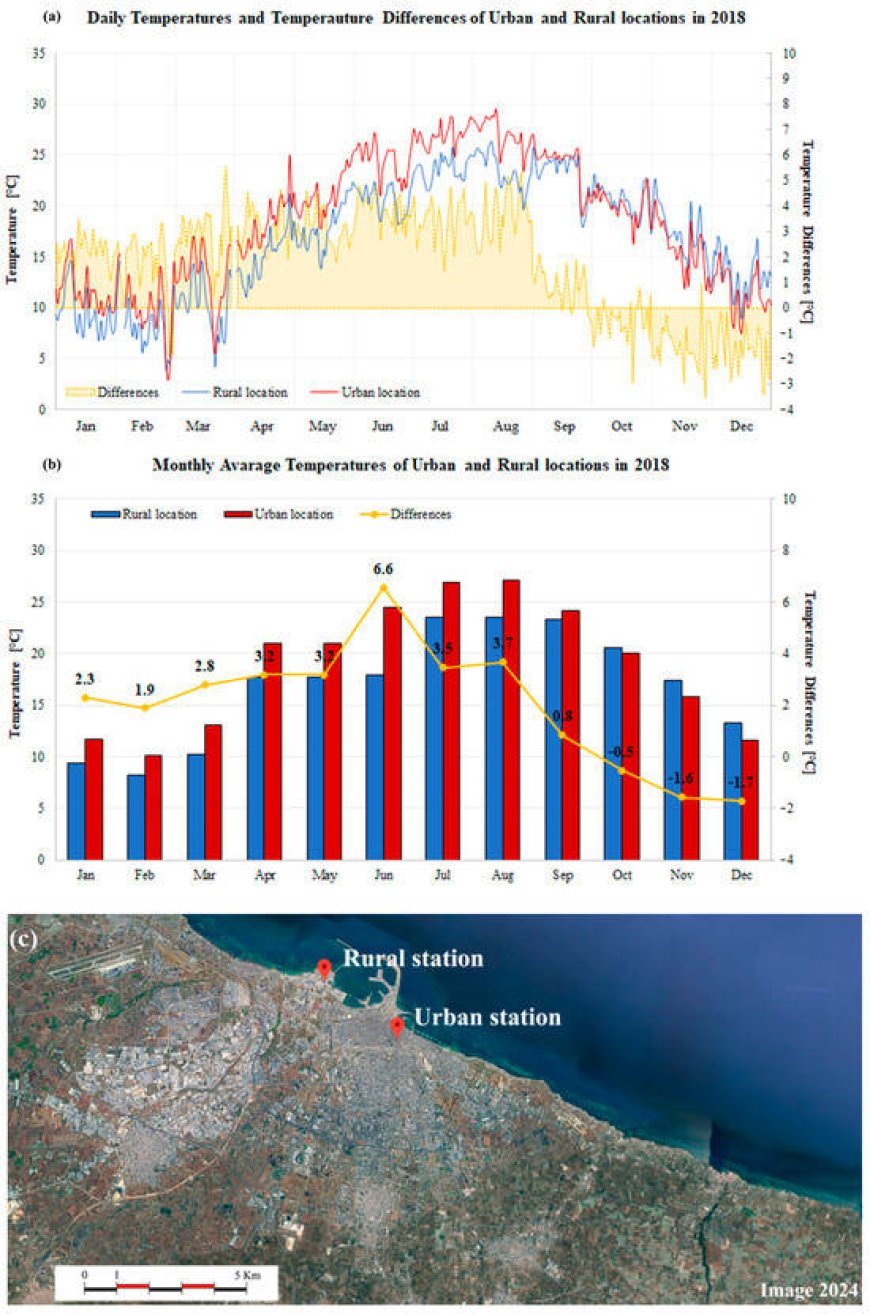
The urban heat island (UHI) effect is one of the largest climate-related issues concerning our cities due to the localized temperature increase in highly urbanized areas. This paper aims to investigate the impact of UHI mitigation techniques in promoting climate resilience, by reducing urban air temperatures and cooling energy consumption in buildings. To this end, four mitigation solutions regarding the building envelope—green roofs, green walls, cool roofs, and cool walls—were investigated for the city of Bari in Southern Italy and compared with the current baseline scenario. Hence, five scenarios were simulated—using the ENVI-met microclimate software—during three representative summer days, and the resulting microclimate changes were assessed. Based on these analyses, new climate files—one for each scenario—were generated and used as input to run energy simulations in EnergyPlus to estimate the building cooling consumption. Coupling the microclimate and the consumption outcomes, the mitigation strategies were evaluated from both an urban and building point of view. The study shows that urban characteristics, mainly geometry and materials, are crucial for the UHI phenomenon. All the applied technologies seem to be effective. However, green walls proved to be more efficient in reducing outdoor temperatures (1 °C reduction in daily temperatures), while cool walls performed better in reducing cooling energy consumption, with an overall saving of 6% compared to the current scenario.
Climate, Vol. 12, Pages 113: On the Role of the Building Envelope on the Urban Heat Island Mitigation and Building Energy Performance in Mediterranean Cities: A Case Study in Southern Italy
Climate doi: 10.3390/cli12080113
Authors: Alessandra Martinelli Francesco Carlucci Francesco Fiorito
The urban heat island (UHI) effect is one of the largest climate-related issues concerning our cities due to the localized temperature increase in highly urbanized areas. This paper aims to investigate the impact of UHI mitigation techniques in promoting climate resilience, by reducing urban air temperatures and cooling energy consumption in buildings. To this end, four mitigation solutions regarding the building envelope—green roofs, green walls, cool roofs, and cool walls—were investigated for the city of Bari in Southern Italy and compared with the current baseline scenario. Hence, five scenarios were simulated—using the ENVI-met microclimate software—during three representative summer days, and the resulting microclimate changes were assessed. Based on these analyses, new climate files—one for each scenario—were generated and used as input to run energy simulations in EnergyPlus to estimate the building cooling consumption. Coupling the microclimate and the consumption outcomes, the mitigation strategies were evaluated from both an urban and building point of view. The study shows that urban characteristics, mainly geometry and materials, are crucial for the UHI phenomenon. All the applied technologies seem to be effective. However, green walls proved to be more efficient in reducing outdoor temperatures (1 °C reduction in daily temperatures), while cool walls performed better in reducing cooling energy consumption, with an overall saving of 6% compared to the current scenario.
What's Your Reaction?