Climate, Vol. 11, Pages 242: Multi-Hazard Extreme Scenario Quantification Using Intensity, Duration, and Return Period Characteristics
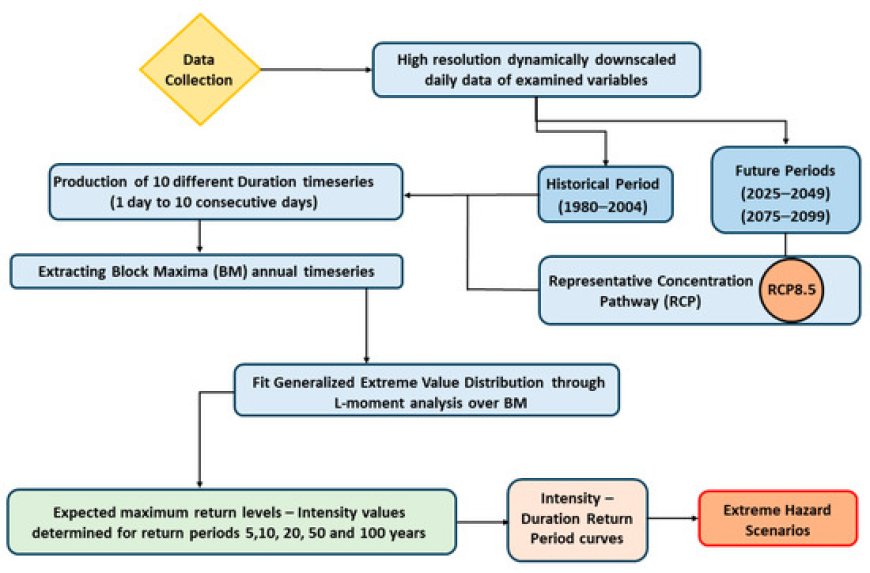
Many modern frameworks for community resilience and emergency management in the face of extreme hydrometeorological and climate events rely on scenario building. These scenarios typically cover multiple hazards and assess the likelihood of their occurrence. They are quantified by their main characteristics, including likelihood of occurrence, intensity, duration, and spatial extent. However, most studies in the literature focus only on the first two characteristics, neglecting to incorporate the internal hazard dynamics and their persistence over time. In this study, we propose a multidimensional approach to construct extreme event scenarios for multiple hazards, such as heat waves, cold spells, extreme precipitation and snowfall, and wind speed. We consider the intensity, duration, and return period (IDRP) triptych for a specific location. We demonstrate the effectiveness of this approach by developing pertinent scenarios for eight locations in Greece with diverse geographical characteristics and dominant extreme hazards. We also address how climate change impacts the scenario characteristics.
Climate, Vol. 11, Pages 242: Multi-Hazard Extreme Scenario Quantification Using Intensity, Duration, and Return Period Characteristics
Climate doi: 10.3390/cli11120242
Authors: Athanasios Sfetsos Nadia Politi Diamando Vlachogiannis
Many modern frameworks for community resilience and emergency management in the face of extreme hydrometeorological and climate events rely on scenario building. These scenarios typically cover multiple hazards and assess the likelihood of their occurrence. They are quantified by their main characteristics, including likelihood of occurrence, intensity, duration, and spatial extent. However, most studies in the literature focus only on the first two characteristics, neglecting to incorporate the internal hazard dynamics and their persistence over time. In this study, we propose a multidimensional approach to construct extreme event scenarios for multiple hazards, such as heat waves, cold spells, extreme precipitation and snowfall, and wind speed. We consider the intensity, duration, and return period (IDRP) triptych for a specific location. We demonstrate the effectiveness of this approach by developing pertinent scenarios for eight locations in Greece with diverse geographical characteristics and dominant extreme hazards. We also address how climate change impacts the scenario characteristics.
What's Your Reaction?