CivilEng, Vol. 5, Pages 65-88: Factors Affecting Properties of Polymer Grouted Sands
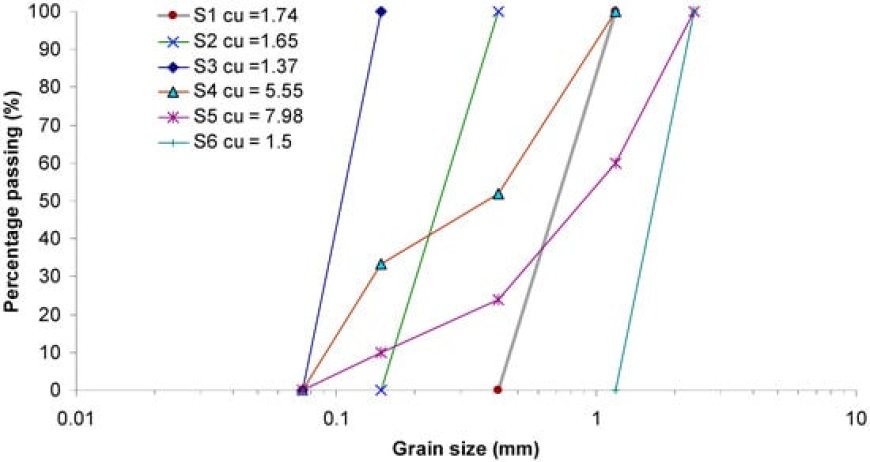
The aim of this research was to undertake laboratory testing to investigate the beneficial effects of epoxy resin grouts on the physical and mechanical properties of sands with a wide range of granulometric characteristics. Six sands of different particle size and uniformity coefficients were grouted using epoxy resin solutions with three ratios of epoxy resin to water (3.0, 2.0 and 1.5). A set of unconfined compressive strength tests were conducted on the grouted samples at different curing periods and a set of long-term unconfined compressive creep tests in dry and wet conditions after 180 days of curing were also carried out in order to evaluate the development of the mechanical properties of the sands, as well as the impact of water on them. The findings of the investigation showed that epoxy resin resulted in appreciable strength values in the specimens, especially those of fine sands or well graded sands, grouted with the different epoxy resin grouts. Whilst the higher compressive strength and elastic modulus values at the age of 180 days were obtained for the finer sand, which ranged from 2.6 to 5.6 MPa and 216 to 430 MPa, respectively, the lower compressive strength and elastic modulus values were attained for the coarser sand with low values of the coefficient of uniformity, which varied from 0.68 to 2.2 MPa and 75 to 185 MPa, respectively. Moreover, all grouted sands showed stable long-term creep behaviour, with high values of the creep limit ranging from 67.5 to 80% of compressive strength. The presence of water had a negative marginal effect in the majority of the grouted specimens. In terms of physical properties, the permeability and porosity were estimated. The permeability of fine sands or well graded sands was decreased by two to four orders of magnitude. Using laboratory results and regression analysis, three mathematical equations were developed that relate each of the dependent variables of compressive strength, elastic modulus and coefficient of permeability to particular explanatory variables.
CivilEng, Vol. 5, Pages 65-88: Factors Affecting Properties of Polymer Grouted Sands
CivilEng doi: 10.3390/civileng5010004
Authors: Costas A. Anagnostopoulos Vasilios Aggelidis
The aim of this research was to undertake laboratory testing to investigate the beneficial effects of epoxy resin grouts on the physical and mechanical properties of sands with a wide range of granulometric characteristics. Six sands of different particle size and uniformity coefficients were grouted using epoxy resin solutions with three ratios of epoxy resin to water (3.0, 2.0 and 1.5). A set of unconfined compressive strength tests were conducted on the grouted samples at different curing periods and a set of long-term unconfined compressive creep tests in dry and wet conditions after 180 days of curing were also carried out in order to evaluate the development of the mechanical properties of the sands, as well as the impact of water on them. The findings of the investigation showed that epoxy resin resulted in appreciable strength values in the specimens, especially those of fine sands or well graded sands, grouted with the different epoxy resin grouts. Whilst the higher compressive strength and elastic modulus values at the age of 180 days were obtained for the finer sand, which ranged from 2.6 to 5.6 MPa and 216 to 430 MPa, respectively, the lower compressive strength and elastic modulus values were attained for the coarser sand with low values of the coefficient of uniformity, which varied from 0.68 to 2.2 MPa and 75 to 185 MPa, respectively. Moreover, all grouted sands showed stable long-term creep behaviour, with high values of the creep limit ranging from 67.5 to 80% of compressive strength. The presence of water had a negative marginal effect in the majority of the grouted specimens. In terms of physical properties, the permeability and porosity were estimated. The permeability of fine sands or well graded sands was decreased by two to four orders of magnitude. Using laboratory results and regression analysis, three mathematical equations were developed that relate each of the dependent variables of compressive strength, elastic modulus and coefficient of permeability to particular explanatory variables.
What's Your Reaction?